Showing posts with label CARANGIDAE. Show all posts
Showing posts with label CARANGIDAE. Show all posts


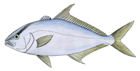


Trachinotus baillonii (Lacepède, 1801)
Posted on at 6:09 AM
in
CARANGIDAE,
Smallspotted dart,
Trachinotus baillonii (Lacepède 1801)
English Name: Smallspotted dart
Family: CARANGIDAE
Local Name: Goru vaali
Order: Perciformes
Size: Max. 54 cm
Specimen: MRS/P0l 22/87

Distinctive Characters: First dorsal fin with 6 spines, second dorsal with 1 spine and 20-24 rays. Anal fin with 2 detached spines followed by I spine and 20-24 rays. Gill rakers on lower limb of first gill arch (including rudiments) 15-19. Body elongate to oval and strongly compressed. Dorsal fin lobe consistently shorter than anal fin lobe in larger specimens.
Colour: Adults silvery blue to grey above, silvery white below. Sides with 1-5 small black spots in a longitudinal row on or near lateral line (usually equal or smaller than eye). Spots absent in juveniles. Second dorsal, anal and caudat fins grey to black, lobes usually darkest.
Habitat and Biology: Occurs in surge zone along sandy beaches, often in very shallow waters. Usually seen in small schools. Feeds on small fishes.
Distribution: Widely distributed in Indo-West Pacific.
Remarks: Trachinotus haillonii is commonly found in small groups in lagoons and besides shallow reefs. On sunny days its silver colouration makes it almost invisible as it swims above the white sand.
Family: CARANGIDAE
Local Name: Goru vaali
Order: Perciformes
Size: Max. 54 cm
Specimen: MRS/P0l 22/87

Distinctive Characters: First dorsal fin with 6 spines, second dorsal with 1 spine and 20-24 rays. Anal fin with 2 detached spines followed by I spine and 20-24 rays. Gill rakers on lower limb of first gill arch (including rudiments) 15-19. Body elongate to oval and strongly compressed. Dorsal fin lobe consistently shorter than anal fin lobe in larger specimens.
Colour: Adults silvery blue to grey above, silvery white below. Sides with 1-5 small black spots in a longitudinal row on or near lateral line (usually equal or smaller than eye). Spots absent in juveniles. Second dorsal, anal and caudat fins grey to black, lobes usually darkest.
Habitat and Biology: Occurs in surge zone along sandy beaches, often in very shallow waters. Usually seen in small schools. Feeds on small fishes.
Distribution: Widely distributed in Indo-West Pacific.
Remarks: Trachinotus haillonii is commonly found in small groups in lagoons and besides shallow reefs. On sunny days its silver colouration makes it almost invisible as it swims above the white sand.
Seriola rivoliana Valenciennes, 1833
Posted on at 6:02 AM
in
Almaco jack,
CARANGIDAE,
Seriola rivoliana Valenciennes 1833
English Name: Almaco jack
Family: CARANGIDAE
Local Name: Andhun mas
Order: Perciformes
Size: Common to 70 cm; max. 1.1 m
Specimen: MRS/P01 19/87

Distinctive Characters: First dorsal fin with 7 spines, second dorsal with 1 spine and 27-33 rays. Anal fin with 2 detached spines followed by 1 spine and 18-22 rays. Gill rakers (excluding rudiments) on the first arch 22-26. Body elongate, moderately deep and slightly compressed. Upper jaw broad at end, extending to below posterior midpoint of pupil. No scutes on lateral line. Grooves present on caudal peduncle.
Colour: Pale brown. Dark bar extending from eye to dorsal spine (most marked in juveniles). Fins mostly dark; pelvics may be white ventrally; anal fin usually with white lobe; caudal with pale margin.
Habitat and Biology: Oceanic and semi-demersal at depths of 30-160 m. Rarely found in inshore waters. Small juveniles are found offshore, under floating plants and debris. Feeds on fish.
Distribution: Circumtropical.
Remarks: The distinctive dark eye bar of Seriola rivoliana gives this species its local name, andhun being the Dhivehi word for kohl.
Family: CARANGIDAE
Local Name: Andhun mas
Order: Perciformes
Size: Common to 70 cm; max. 1.1 m
Specimen: MRS/P01 19/87

Distinctive Characters: First dorsal fin with 7 spines, second dorsal with 1 spine and 27-33 rays. Anal fin with 2 detached spines followed by 1 spine and 18-22 rays. Gill rakers (excluding rudiments) on the first arch 22-26. Body elongate, moderately deep and slightly compressed. Upper jaw broad at end, extending to below posterior midpoint of pupil. No scutes on lateral line. Grooves present on caudal peduncle.
Colour: Pale brown. Dark bar extending from eye to dorsal spine (most marked in juveniles). Fins mostly dark; pelvics may be white ventrally; anal fin usually with white lobe; caudal with pale margin.
Habitat and Biology: Oceanic and semi-demersal at depths of 30-160 m. Rarely found in inshore waters. Small juveniles are found offshore, under floating plants and debris. Feeds on fish.
Distribution: Circumtropical.
Remarks: The distinctive dark eye bar of Seriola rivoliana gives this species its local name, andhun being the Dhivehi word for kohl.
Subscribe to:
Posts (Atom)